
ESPL INSIGHTS
How ML helps engineers screen thousands of design candidates and reduce CAE simulation time
Equilibriums Solutions Pvt. Ltd. · 6 min read
What Is Design of Experiments (DoE)?
Design of Experiments (DoE) is a structured method for studying how design parameters influence product performance within their practical min-max variation limits. Instead of changing one variable at a time, DoE tests several parameters together, showing which parameters are the key drivers and how they interact. The results feed design optimization, helping engineers reach performance targets faster and at lower development cost.
Advantage- Reaches the required design targets faster.
Disadvantage- Identifies a design space that meets the targets but may not deliver the most optimized design.
Simulation-Based Design of Experiments in CAE
In simulation-based design of experiments, a virtual CAE model replaces physical prototypes. Engineers build a parameterized FEA or CFD model in which each design variable can vary within its practical min-max limits. A sampling method such as full factorial, Taguchi or Latin Hypercube selects a set of design points, and the simulations run automatically for each combination.
The output from each run, such as stress, temperature, pressure drop or efficiency, is collected and used to build a response surface. This forms the basis of a sensitivity analysis, showing which parameters have the strongest effect on performance, how they interact, and which can be relaxed to save cost or weight. All of this happens before any metal is cut, reducing prototype cost and development time.
DoE works equally well for FEA and CFD simulation. For example, when designing an electronics heat sink, fin count, fin height, fin thickness and base thickness can be varied through a set of CFD simulations. The results show which parameters control chip temperature and which only add weight, so the design can be both cooler and lighter.
Similarly, for an automotive mounting bracket, wall thickness, rib height, rib spacing and fillet radius can be studied through FEA. DoE shows how these parameters interact and identifies the combinations that reduce mass while still meeting stress and stiffness targets.
Where Simulation-Based DoE Reaches Its Limit
Computational cost- More parameters mean many more design points, which pushes up hardware and software license costs.
Computation time- Large or detailed simulation models can take hours or days per run. Across a full DoE matrix, the timeline can stretch to weeks or months.
Parameter selection- Leaving out an important variable, or setting unrealistic min-max limits, gives a misleading design space.
Response surface accuracy- A conventional polynomial response surface is a fitted approximation and can miss strong nonlinear behavior between sampled points.
As products become more complex, the number of possible design configurations grows exponentially increasing simulation budget. This is where ML for CAE becomes useful.
Why Add ML to DoE?
Implementing ML means using simulation data more intelligently.
A ML model is trained on a limited set of high-fidelity simulation results. Once validated, this ML surrogate model acts as a fast stand-in for the full simulation and predicts performance for new design configurations in seconds rather than hours. Engineers can then carry out design space exploration across the entire range of options, not just the sampled points, and spend CAE resources only on the most promising candidates. This makes surrogate modeling one of the most practical ways to reduce CAE simulation time without compromising engineering confidence.
ESPL's Implementation Workflow
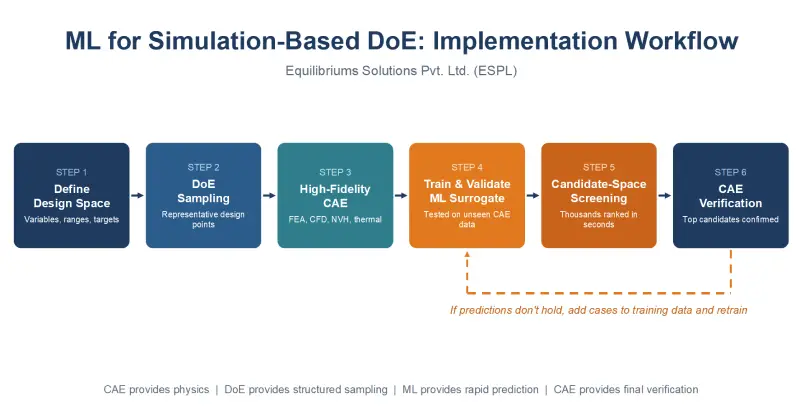
1. Define the design space
Every project starts with the variables, ranges, constraints and performance objectives. The quality of everything that follows, including the ML model, depends on how accurately this step reflects the real engineering problem. Here, our expert team of design and CAE engineers works together, building parameterized geometry and simulation-ready CAD models so that every design variation is generated consistently and is ready for analysis.
2. Generate a representative DoE
A relatively small number of simulation points are selected to capture as much information as possible. Space-filling methods work well for continuous variables, while factorial designs help reveal interactions among a smaller number of parameters. The goal is not to simulate every option, but to build a dataset with enough coverage to train a reliable surrogate.
3. Run high-fidelity CAE
The selected configurations are evaluated using the physics that fits the problem: FEA, CFD, NVH, thermal, durability, multibody dynamics or multi-physics simulation. The results are then checked for failed or non-converged runs and inconsistent inputs. An ML surrogate can only be as dependable as the simulation data behind it.
4. Train and validate the ML surrogate model
Depending on the problem and the data available, the surrogate may use Random Forest, Gradient Boosting, Neural Networks or Gaussian Process Regression. Validation is the critical stage. The model must accurately predict CAE results it has not seen before to the level the engineering decision demands. Fitting the training data alone is not enough.
5. Screen the full candidate space
Once validated, the surrogate evaluates the complete candidate set. Predictions are reliable only within the trained design space, which is why Step 1 matters. Thousands, and in some cases millions, of configurations can be ranked by performance and filtered against engineering constraints, at a fraction of the cost of equivalent high-fidelity simulations. Because each prediction takes seconds, the surrogate also enables a fast sensitivity analysis across the entire design space, not just the sampled points. Engineers see how all the options compare before committing further CAE effort.
6. Verify the leaders with CAE
The top candidates are re-run using the original high-fidelity CAE model. If any prediction does not hold up, that case is added to the training data and the surrogate is retrained. The workflow stays iterative and adaptive rather than a one-time prediction.
Case Study: ML Surrogate for NVH Simulation of Cable and Harness Routing
In a recent automotive NVH project, the task was to understand how cable and harness routing, clamping architecture, damping mass locations and support configurations affected overall NVH performance. Together, these variables created more than 45,000 possible configurations.
45,000+
Candidate configurations
~3 hrs
Per high-fidelity NVH simulation
15.4 yrs
Sequential compute if run one by one
At three hours per run, simulating every configuration would have required about 135,000 simulation hours. Parallel computing can shorten wall-clock time, but it does not remove the workload of 45,000 simulations. Brute-force evaluation was never a realistic option.
Instead, a representative subset was selected through DoE and evaluated using high-fidelity NVH simulation. This dataset was used to train and validate an ML surrogate that could predict the NVH response of configurations it had not seen before. The validated model then screened all 45,000+ candidates and ranked them against the NVH objective. The strongest candidates were re-run with the original simulation model to confirm the predicted performance.
The result: a full sweep of a 45,000+ configuration design space for cable and harness routing NVH optimization, with high-fidelity simulation still making the final call.
ML Accelerates CAE. It Does Not Replace It.
A surrogate model only knows what the CAE data has taught . That is why physics-based simulation stays central at three points: generating trustworthy training data, validating the surrogate before it influences decisions, and confirming final candidates before a design is frozen.
ML is a computational accelerator for CAE-driven design, not a substitute for engineering judgment or simulation-based verification.
Where This Is Heading
As CAE models grow more detailed and product architectures more complex, simulating every configuration directly becomes harder to justify in time and compute cost. DoE provides structured sampling, optimization algorithms provide intelligent search, and ML provides fast, validated surrogates built from structured simulation data.
The goal is not just to run fewer simulations. It is to explore more of the design space, find better solutions and make faster, evidence-based engineering decisions, with high-fidelity CAE as the foundation.
At ESPL, we are actively implementing this AI/ML- enabled CAE approach on live engineering programs across CFD, NVH, structural, durability, thermal management and e-powertrain applications. Since 2006, our Pune-based team has delivered CAE services in India and globally, with a strong focus on automotive engineering. For us, ML- enabled DoE is a natural next step: combining physics-based simulation with data-driven speed to support design decisions from concept through virtual validation.
CAE provides physics. DoE provides structured sampling. ML provides rapid prediction. High-fidelity CAE provides final verification.
Equilibrium Solutions Pvt. Ltd.
Email: info@eqmsol.com
Phone: +91-20-25420085
Contact Point: Mr. Adwait Gokhale
Was this article useful for you? Do provide your valuable feedback.
Note:
The content of this article including other information mentioned on the website
www.eqmsol.com is proprietary of Equilibrium
Solutions Pvt.
Ltd. Unauthorized use/copy of
any content wholly or partly is prohibited. Thanks for the promoting awareness about
intellectual properties.